A CLUSTER is a group of similar things or people positioned or occurring closely together. My solarplate print Night Dreams, is currently in an invitational show, CLUSTER, at IceCube Gallery in Denver.
My dreams tend to have clusters of images, ideas, fears, or emotions [...]]]>
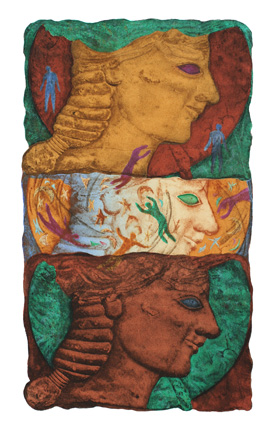
Night Dreams
© 1998. Linda C Everson
28″h x 20″w framed
A CLUSTER is a group of similar things or people positioned or occurring closely together. My solarplate print Night Dreams, is currently in an invitational show, CLUSTER, at IceCube Gallery in Denver.
My dreams tend to have clusters of images, ideas, fears, or emotions that keep repeating themselves over and over. And I may have these dreams multiple times… sometimes months or years later. These are called “repetition dreams”. I quite often dream of flying, floating, or falling and I can’t ever stop that process.
In my print, Night Dreams, I included many small figures; some floating, some standing. The figures cluster, swirl, and lurk on top of and around the goddess faces. The multiple faces create a multi-tiered level of mystery. Sigmund Freud said that “dreams are the window to the sub-conscious”.
Bertil Vallien, who’s famous for his sandcasted glass sculptures, often included small floating figures in his vast boat and torso sculptures. His beautiful artwork influenced my own use of floating figures and also the use of vibrant color, transparency, and multiple layers of imagery.
A SOLARPLATE is a steel backed POLYMER PLATE that is light sensitive. Transparencies can be exposed unto the plates by sunlight or UV light boxes. In the Goddess series, I used Kodalith transparencies of photos of goddess faces which I spliced together after printing them in the darkroom. I drew the floating figures onto these transparencies with a opaque pen. After exposure, the solarplate was etched in water which dissolved the unexposed areas, creating textures in the plate.
To create the multiple “flat” background colors (greens, ochres, rust, tan) I made acetate cutouts (like a puzzle) which were rolled with the etching ink and then printed on paper on an etching press. Dark brown and ochre inks were then wiped onto the textured solarplate, and that was printed on top of the flat colors. This required tedious registration and many runs through the etching press to create all the layers of color.
Several years ago, I did a whole series of solarplate prints called the Goddess Series and another called the Torso Series, all based on Greek and Roman sculptures and reliefs which I photographed. In many of those prints, I included small floating figures that swirled through the larger figurative images and/or backgrounds. Some other Goddess and Torso prints that are not in the Exhibit and also are not on my website are depicted below. Please see my CONTACT PAGE is you’re interested in more information.
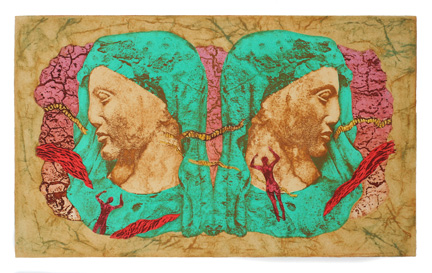
Mirror Image
© 2002. Linda C Everson
18″h x 11″w image size
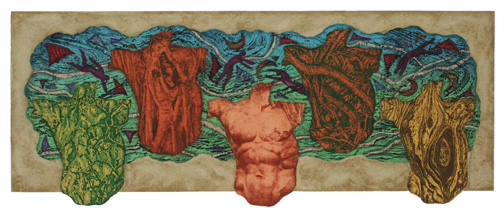
Paper Doll Torsos
©2001. Linda C Everson
10″h x 25″w image size
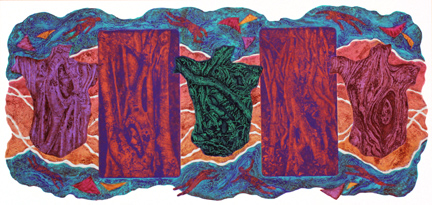
Enchantment of the Trees and Forest
© 1997. Linda C Everson
11″h x 24″w image size
]]>
I too have [...]]]>
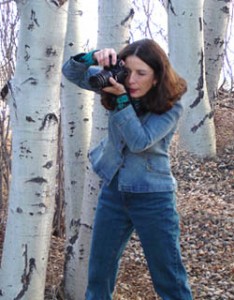 Arbor Day was celebrated recently and it makes me think of my father! He was always planting trees and bushes, and I remember neighbors saying that if he planted a broom, it would also grow. Arbor Day, which is usually celebrated on the last Friday in April, encourages the planting of trees.
I too have a penchant for trees, and they are a source of imagery for my artwork. ‘Arbor’ pertains to trees and a ‘glyph’ is ‘a symbol used for non-verbal communication’.
I began my series of Arborglyph monoprints back in 2002. I was photographing textures (natural scarring and peeling) on aspen tree bark, and decided to use those images in my printmaking endeavors. I took the negatives and enlarged them in the darkroom. To my delight, the images looked symbolic and resembled calligraphy or characters. I exposed the images to solarplates (photographic printmaking plates) and then printed them onto paper on an etching press. I began with 6″x 6″ solarplates, but quickly starting combining several solarplates with other printmaking techniques to create larger, more complex monoprints. I am still working on that series today. See my PORTFOLIO, Arborglyphs.
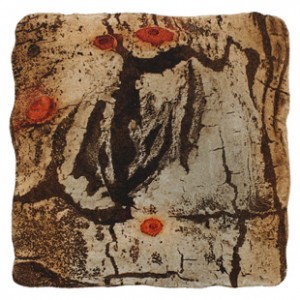
Arborglyph: (1 symbol 3) I
© 2002 Linda C. Everson, All Rights Reserved.
Later, I heard an interesting discusssion about aspen carvings on Colorado Public Radio (KCFR). They were talking about Arborglyphs in the southwestern states. Apparently, the name I was using for my monoprint series is also the name used for the graffiti carved into aspen trees by Basque and Hispanic shepherds while tending their animals from the early 1800’s – 1950’s. Because aspen trees do not have a long life span, documentation is currently being made of these older graffiti laden trees before they die and their legend disappears. Several articles have recently been written about these Arborglyph trees, and many people at art festivals have commented on certain trails to take to find these shepherd images.
Sometimes I photograph the man-made graffiti on the aspen trees, but generally I prefer the natural scarring and peeling. I’ve found that imagery provides more abstracted, symbolic images which tend to look more like calligraphy, and have a more mysterious overtone. I’ve created my own pictorial language of glyphs and actually have my own ‘invented language’.
I also incorporate the glyphs in my artwork into the title signature line on the monoprint.
]]>